

Spring is in the air, and you know what that means: Spring travel!
As I am planning for our next trip when we will use several airlines, ranging from ultra low cost to legacy/network carriers, I thought you may find tips on flying with low-budget airlines helpful as their rules are quite different than of the network airlines that most of us use.
Just in case you’re not familiar with the terminology, let’s briefly categorize types of carriers. There are 3 main types of carriers: ultra low cost, low cost and legacy or network carriers. Spirits, Frontier, Allegiant, Sun Country are examples of the ultra low cost carriers. Low cost carriers include Southwest, Virgin America and JetBlue. Network or legacy carriers are the big airlines such as United, American and Delta.
Firstly, have you ever flown with any low cost carriers? Have you found really cheap tickets but hesitated to book because you’re not familiar with the airline? I fully understand because this was me a few years ago!! Since we pay for our own travels, and as a family of four, everything adds up very quickly. Therefore, we decided to try out the low cost carriers whenever there’s a big difference in price between them and other network airlines. So far, we haven’t had too many issues with them, but it does take some time to getting used to their rules and regulations. But once you understand their restrictions, then traveling with them could be more pleasant.
Keep in mind that since they are low cost carriers, the fare typically only covers for the flight taking you from point A to point B, and nothing else! It’s just like riding a bus where you just pay for the ride only. On the bus, they don’t give you free beverage or snacks or anything else. If you have this understanding down, then you shouldn’t have any problem at all! I find this pricing model making perfect sense! I can just bring my own water and snacks to eat; or I can purchase them on the flight for a few dollars. So instead of having to pay an extra 100 USD for a flight with other network airlines because they provide soft drinks and cookies, I would rather save 100 USD (per person) and bring my own food! I’m not saying that it it not nicer to fly with network carriers, but if the airfare difference is significant, then I think choosing to fly with a low-cost carrier is not a bad idea!

If your budget philosophy is similar to what I described above, then the tips below will help you to be more informed of the rules and hopefully in turn will save you a little bit of money as well.
Baggage Allowance
- Hold/Checked Baggage
- Regular baggage allowance for most U.S. airlines is 50 pounds (23 kg) per luggage, while most Asian airlines allow up to 70 pounds (32 kg). These weight limits become almost like the standard that no one even bothers to check otherwise. However, this could get you in trouble if you happen to fly with a ultra low or low cost airlines such as Spirits, Frontier, Allegiant. Their regular hold/checked luggage weight allowance is 40 pounds (18 kg) only. Similarly, if you travel within Europe, most likely you would use airlines such as EasyJet, a European low-cost carrier. EasyJet gives you the option to purchase baggage allowance for 15 kg, 23 kg or 32 kg. To avoid extra charges or having to shuffle your belongings in the middle of the airport, be sure to check baggage allowance before you pack!
Note: Since June 3, 2024, Spirits airline now allows 50 pounds per checked baggage instead of 40 pounds previously.
- Regular baggage allowance for most U.S. airlines is 50 pounds (23 kg) per luggage, while most Asian airlines allow up to 70 pounds (32 kg). These weight limits become almost like the standard that no one even bothers to check otherwise. However, this could get you in trouble if you happen to fly with a ultra low or low cost airlines such as Spirits, Frontier, Allegiant. Their regular hold/checked luggage weight allowance is 40 pounds (18 kg) only. Similarly, if you travel within Europe, most likely you would use airlines such as EasyJet, a European low-cost carrier. EasyJet gives you the option to purchase baggage allowance for 15 kg, 23 kg or 32 kg. To avoid extra charges or having to shuffle your belongings in the middle of the airport, be sure to check baggage allowance before you pack!
- Carry-on Baggage
- Carry-on weight allowance difference should also be noted. Most U.S. airlines do not check the weight of your carry-on bags. However, there is an implied weight limit of 22 pounds for the carry-on bag and a total of 26 pounds for all of the carry-on and personal bags combined.
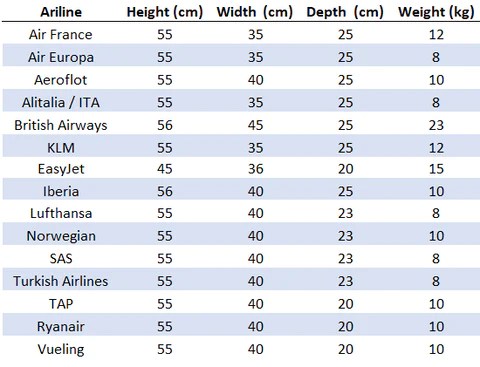
- European low-cost airlines allow carry-on luggage weight ranging from 8 to 15 kg. Note that smaller aircrafts often imply lesser weight allowance from the above range. Below is the carry-on size and weight allowance for most European airlines.
- Personal bag
- Low-budget airlines allow each person a personal bag, which is the size of a regular backpack or a laptop bag. Ladies need to take note that if you carry a purse, then it needs to be inside the personal bag; otherwise, they will count your purse as a separate item, and you will be required to pay a fee. If you travel with children who have their own ticket, then they are also entitled to a personal bag of the same size. Children typically do not carry bags of that size, so tip is bring a bigger bag at the allowed size, and then put your kid’s bag/backpack inside, so you can have room for more things (you can carry the bag for them!) It would be a waste to use a small kid’s backpack as the allowed personal bag.
Hidden Fees
The reason we choose to fly on ultra low cost airlines is of course to save money. The airfares are typically cheaper than most other network airlines for the same routes. However, if you don’t know their rules, then the fees can add up, and you will end up not saving much or at all.
Baggage fees
With network airlines, the baggage fees are the same, regardless of when you pay for it. With budget airlines, your baggage fees would be the cheapest when you purchase your tickets. Baggage fees will cost more at the time of check-in (online) and will almost double if you wait to pay at the airport. This is true for some European airlines such as EasyJet as well. So plan ahead and pay for baggage fees when you purchase your tickets.
Convenience fee
If you read the fine prints of the charged fees when purchasing your tickets, you will notice a convenience fee (typically around 22 USD for domestic flights). This fee can be omitted if you purchase your tickets at the airport at the check-in counter. So if you know in advance, then you can book the tickets the next time you’re at the airport, or if you live near the airport, then doing this could save you quite a bit, especially if you have many people in your group. So far, I only know this to be true for Spirits airline. Other airlines also charge similar fees, but none of them offer a way to avoid this fee.
Seat Selection
These days, most airlines charge extra fees if you want to select your own seats. If you opt for auto-assigned seats to avoid this fee, then there’s a trick. I can’t say this trick works all the time, but it has worked on most times that I’ve tried.
U.S. airlines allow you to check-in for your flight 24 hours in advance (some airlines such as Southwest allow you to check in 36 hours before the flight for a fee), and we typically try to check in as soon as the check-in window is open so we can get better boarding position and seat assignment. Note that to me, I prefer seats in the middle or the front, and not in the back (due to loud engine noise and near the restrooms). So checking in early typically means I have a better chance of getting seats in the front or the middle of the plane. However, with low-budget airlines such as Spirits, it works differently: early check-in usually gives you seats in the back instead. So don’t rush to check in as soon as the check-in window opens if you don’t want to sit in the back of the plane. This is not a written rule, and there isn’t a definite check-in window that can guarantee front seats. However, I typically check in later and was able to get seats in the front most of the time!
Fee for printing boarding pass at the airport
Most low-budget airlines will charge you fee for printing the boarding pass at the airport – they call this Airport agent assistance service. Therefore, after checking in, you should (1) print your boarding pass at home, (2) download the airline app so you can access the boarding pass from there, (3) screenshot your boarding pass. If in the situation where you cannot check-in, either due to technical difficulty on your side or if their website malfunctions, be sure to screenshot the error so you can show the airport agent. That way, they will not charge you the fee for Airport assistance service.

In-Flight Service
- If you travel with a low-budget airline, then drinks and snacks are not complimentary, not even water! Note that regular drinking water is not complimentary, but hot water is! So if you don’t want to pay a few dollars for a bottle of water, then bring some tea or instant coffee bags and ask for hot water (this seems more reasonable than asking just for hot water to drink). If you have little babies that like to drink warm milk/formula, the flight attendant will give you hot water in the baby bottle. Either wait for it to cool, or mix it with regular water and your baby can have warm milk/formula!
- Besides sweets and snacks, Spirits airline is the only U.S. airline I know that offers instant ramen for purchase. The last time we purchased, the price was 4 USD per noodle cup, and the selections are limited. To be honest, it’s a good deal if you purchase this for dinner; more filling than eating chips and crackers. However, if you don’t want to pay or prefer a certain flavor, then bring your own noodle cup and then ask for “free” hot water, and you’re set!

Going on trips at the rate of every or every other month, times 4, we have learned to become less picky about airlines so we can save on airfare! Given, these flights need to be short enough to tolerate the smaller seats and limited service. And it would be a good idea to fly non-stop flights only to avoid the chance of having delayed connection flights as these low-cost carriers have fewer aircrafts than the major airlines. We are willing to splurge for the long-haul flights, and save on the shorter flights. As long as the flight can take us from point A to point B safely and not delayed too often, then I think flying with a low-cost carrier can be a budget-smart option. I hope you find these tips helpful and encouraging as you to book that cheap ticket from the non-major airlines. Save on the airfare so you have more to spend on a nice hotel/accommodation and excursions. Cheers to smart travel!





 Making Memories
Leave a reply to Ý-An Cancel reply