Standing at over 12,000 feet, Mount Fuji (Fuji-san) is Japan’s tallest and most iconic mountain—and so much more than just a beautiful backdrop. With its near-perfect symmetry, Mount Fuji has long been considered sacred, deeply tied to Japan’s spiritual connection with nature. It’s believed to be home to powerful Shinto deities, a place of Buddhist-Shinto pilgrimage, and a symbol of rebirth and purification. For centuries, climbing Fuji wasn’t just a physical challenge but a spiritual journey—one that marked a transition from the everyday world to something higher and more meaningful.
You can spot Fuji-san from many parts of the country, its near-perfect cone rising in the distance. But seeing it from afar and standing in its presence are two very different experiences. Up close, its scale, stillness, and quiet power feel almost humbling in a way photos can’t capture. A trip to Japan doesn’t feel truly complete without taking the time to experience Fuji-san—not just as a landmark, but as a moment that stays with you.
Oshino Hakkai
Of course, nothing beats spending a night or two near Mount Fuji—especially around the Fuji Five Lakes area like Kawaguchiko or Lake Yamanaka. But if your time in Japan is limited, a day trip to see Fuji-san is still absolutely worth it. In this post, I’ll share a Mount Fuji day trip guide, including the best routes and itineraries from Tokyo and nearby cities, to help you plan a smooth and memorable visit.
Fun fact: It’s a common misconception that the “san” in Fuji-san is the honorific—making it sound like “Mr. Fuji.” In this case, “san” doesn’t refer to a title at all. It actually means mountain, so Fuji-san simply translates to Mount Fuji or Fuji Mountain.
By Tour
There are so many different ways to experience Fuji-san, and tours make it easy to see several great viewpoints in one day. Whether you’re hoping to capture the perfect photo, try local food, or learn more about the area’s culture, there’s a tour that fits your travel style. You can join an organized day tour from cities like Tokyo, Kyoto, or Osaka, or make your way to Kawaguchiko and find a local guide(not sponsored) for a more relaxed, personalized experience.
If you live in or are traveling from California and are interested in joining a tour to Japan, I recommend connecting with Mimi’s Travel World. Her tours are highly personalized, with itineraries that can be adjusted during the trip—whether to accommodate the weather or the group’s preferences.
Although we traveled independently for most of our Japan trip, we joined Mimi’s group for some parts of our Mount Fuji day trip, and it was one of the most relaxed days. The pace was easy, never rushed, and everyone in the group was treated more like friends than tour participants.
While her tours are primarily geared toward Vietnamese travelers, Mimi also offers flexible travel coordination and can help arrange anything you need. Our private car with a driver for the Mount Fuji day was arranged through Mimi’s Travel World, and it made the experience smooth and stress-free. (Note: this is not sponsored. Recommending Mimi simply because we thought her tour was very flexible and accommodating. We have been friends since elementary school; she’s someone I trust enough to offer my recommendation.)
Mimi and Me at Mount Fuji’s 5th Station
Traveling Solo
If you’re traveling solo or simply prefer not to follow an organized tour, getting to the Mount Fuji area on your own is very doable—and often the most budget-friendly option. From Tokyo, the Fuji Excursion Limited Express runs directly from Shinjuku to Kawaguchiko, making the journey straightforward and stress-free. Coming from Osaka or Kyoto, you can take the Shinkansen and connect to a local train or bus to reach the Fuji area.
Maple Corridor
Once you arrive in Kawaguchiko, getting around is easy. The Fujikko Sightseeing Bus stops at all the main attractions, or you can rent a bike and explore at your own pace.
If you’re visiting as a day trip, be sure to check train and bus timetables in advance so you don’t miss the last ride back.
Traveling as a Group
If you’re traveling as a group and don’t want to follow a structured tour, consider hiring a car with a driver for the day. It often turns out to be more economical than booking multiple tickets—and it’s by far the most convenient option. You won’t need to worry about navigating unfamiliar roads or train schedules, and your itinerary stays completely flexible.
Most drivers are locals, which adds an extra layer to the experience. Along the way, they can share insider tips, point out lesser-known spots, and even offer a bit of local history you might otherwise miss.
Sharing Our Itinerary
One of the biggest advantages of exploring on your own is the freedom to create an itinerary that works for you. Depending on the season and weather conditions, some spots around Mount Fuji may not be accessible. Since it’s impossible to know the weather in advance, I put together two itineraries: one that includes a visit to Mount Fuji’s 5th Station, and one that skips it entirely.
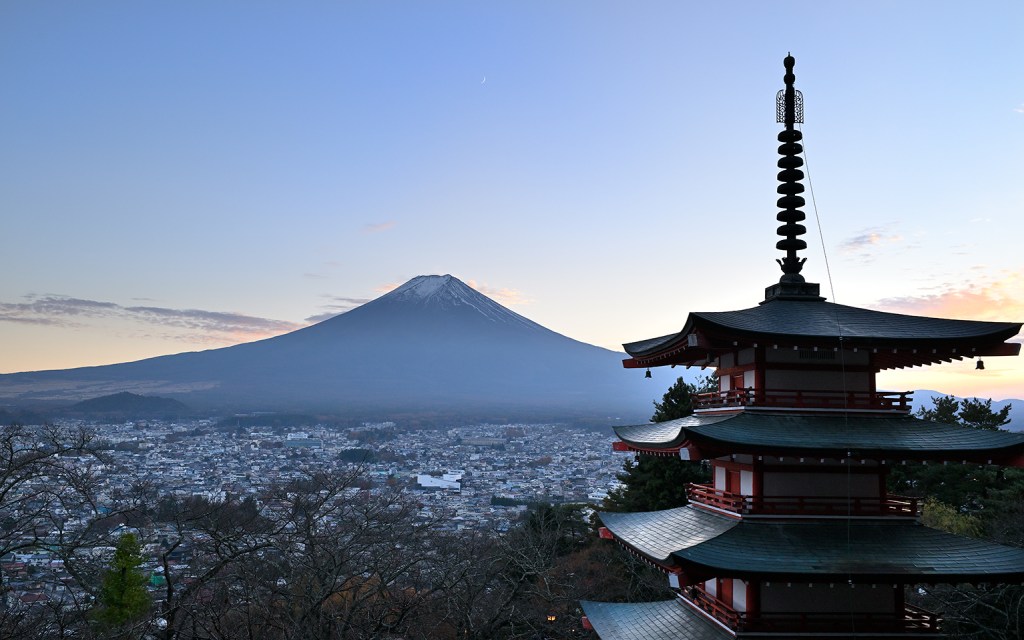
From Chureito Pagoda
We hired a car with a driver for the day, which allowed us to visit all the major viewing spots comfortably and without feeling rushed. The only thing we missed out on was dining at the famous Hōtō Fudō noodle restaurant—it’s incredibly popular and only accepts reservations for very large groups.
One thing to keep in mind: our drive back to Tokyo took longer than expected due to traffic (which we anticipated). These itineraries were planned for our Fall visit in late November, when daylight hours are shorter. If you’re visiting during the warmer months, you’ll have the advantage of longer daylight, giving you more flexibility to linger at each stop—or you could start earlier in the day to beat the crowds, since most tours leave Tokyo around 8 a.m.
Drive ~15m → Honcho Street (20m) 📸 Blue hour retro street, glowing lamps + Fuji
Drive ~15m → Honcho Street (20m) 📸 Same – dusk street + Fuji silhouette
4:45–6:30 p.m.
Drive ~1h45m back to Tokyo
Drive ~1h45m back to Tokyo
6:30 p.m.
Arrive Tokyo
Arrive Tokyo
The itinerary is also designed so that you’ll return to Tokyo by early evening—around 7 p.m.—leaving plenty of time to enjoy the rest of the evening in the city, whether that’s a relaxing dinner, a stroll through a neighborhood, or a quick night visit to a favorite spot. For us, it was a quick dinner and a visit to Shibuya Crossing and Shibuya Sky (last entry at 9:20 p.m.), then late night shopping at Don Quijote.
Final Thoughts
Visiting Fuji-san is one of those experiences that stays with you long after the trip ends. Whether you’re exploring on your own, joining a day tour, or hiring a driver for a more personalized adventure, there’s something magical about seeing Japan’s most iconic mountain up close.
Photo taken with my iPhone
A day trip to Mount Fuji is very doable, but planning ahead makes all the difference—check train schedules, consider traffic if driving, and be ready to adjust your itinerary based on the weather. Even with a few small hiccups (like missing our Hōtō Fudō lunch!), the stunning views, peaceful lakes, and quiet moments around Fuji made the day unforgettable.
If your schedule allows, spending a night or two in the Fuji Five Lakes area lets you soak in the scenery at a more relaxed pace. Even a single day, though, gives you a real sense of why Fuji-san is such an enduring symbol of Japan—and a must-see on any trip.
In a future post, I’ll share our experience spending the night in a town near the Fuji area, where you can enjoy an onsen with a view of the Mount Fuji—one of those moments that perfectly combines relaxation and scenery.



 Making Memories
Leave a comment